
Advanced Biomechanical Modeling
Explore our cutting-edge research projects in cardiac mechanics and gastrointestinal motility modeling
HeartSimSage
HeartSimSage is an attention-enhanced graph neural network (GNN) framework developed by Dr. Lei Shi's team at Kennesaw State University (KSU) in collaboration with researchers from Columbia University and Emory University. It serves as an AI simulation accelerator for finite element analysis (FEA), aiming to replace traditional computationally expensive cardiac biomechanical finite element solvers.
Traditional finite element analysis (FEA) methods provide highly accurate biomechanical modeling of the heart, but they are computationally expensive and difficult to scale for large cohorts or real-time clinical applications. HeartSimSage addresses this challenge by learning the relationship between cardiac geometry, material properties, physiological loading conditions, and resulting tissue deformation directly from simulation data.
Funding & Support
 $522,695
 National Institutes of Health (NIH)
Core funding for the Generative AI and biomechanics heart modeling research project.
Emory University
Clinical validation and medical imaging data support.
Columbia University
Multi-scale modeling methodology collaboration.
Technical Architecture
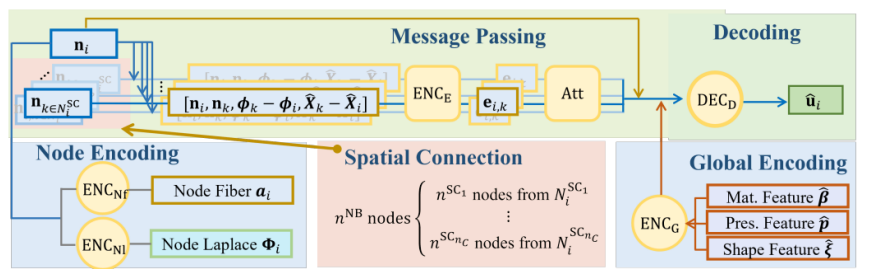
HeartSimSage's core architecture integrates four key technical dimensions to achieve both flexibility and accuracy in cardiac biomechanical simulations.
GraphSAGE-based Topology
Converts cardiac finite element meshes into graph structures with flexible node connectivity.
Laplace-Dirichlet Encoding
Solves Laplace equations on cardiac meshes to encode spatial embedding vectors.
Attention Mechanism
Adaptive message passing that dynamically weights neighboring node influences.
Subset Training
Efficient subgraph sampling strategy that reduces memory requirements.
Performance Results
Published in the Journal of Computational Physics, HeartSimSage achieves unprecedented acceleration while maintaining high-fidelity accuracy.
Publications
HeartSimSage: Attention-enhanced graph neural networks for accelerating cardiac mechanics modeling
Journal of Computational Physics, 2026
Introduces the HeartSimSage framework for AI-accelerated cardiac biomechanical simulations.
Personalized Multiscale Modeling of Left Atrial Mechanics and Blood Flow
Computer Methods in Applied Mechanics and Engineering, 2026
Multiscale electromechanical coupling methodology foundation.
Project Contributors
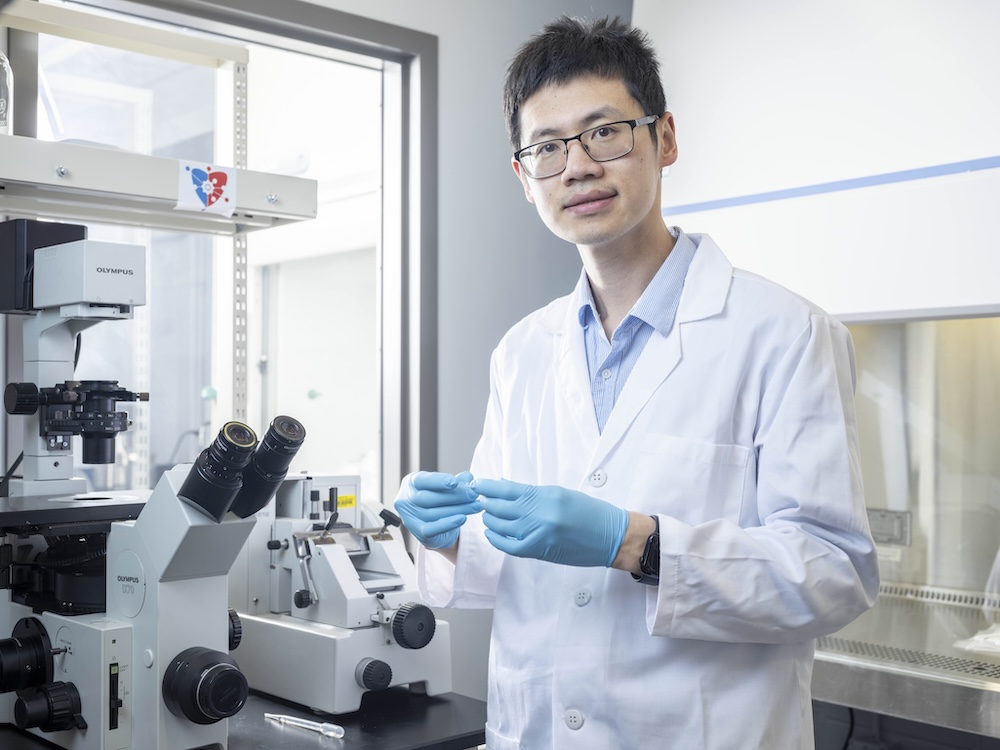
Lei Shi
Principal Investigator
Kennesaw State University
Project Timeline
Key milestones and achievements throughout the project lifecycle.
Project Initiation
NIH R01 funding awarded; project kickoff with team assembly and literature review.
Methodology Development
Development of Laplace-Dirichlet spatial encoding and attention mechanism integration.
Model Training & Validation
Large-scale training on cardiac simulation datasets; validation against clinical data.
Paper Submission
Manuscript submitted to Journal of Computational Physics.
Publication & Dissemination
Paper accepted and published; framework released for research community.
Impact & Applications
HeartSimSage represents an important step toward scalable, AI-driven cardiac digital twins.
Personalized Diagnosis
Enables accurate patient-specific predictions for improved diagnostic accuracy.
Surgical Planning
Supports pre-operative planning through rapid biomechanical simulations.
Treatment Optimization
Facilitates treatment planning by predicting outcomes under different scenarios.
Large-Scale Research
Enables population-scale studies through efficient computation.
Stomach Digital Twin
The Stomach Digital Twin project is an NSF-funded research initiative led by Dr. Lei Shi at Kennesaw State University. This project aims to develop multiscale electromechanical modeling of stomach motility and structure to advance digital twin models for personalized GI health applications.
The stomach is a complex multi-layered organ with nonlinear, large-deformation characteristics. This project integrates microstructure-informed biomechanical models with ion-based electrophysiology to create patient-specific digital twins.
Funding & Support
 $199,208
 National Science Foundation (NSF)
ERI award supporting multiscale electromechanical modeling of stomach motility.
Emory University
Clinical validation and medical imaging data support.
Columbia University
Multi-scale electromechanical coupling methodology.
Technical Architecture
The Stomach Digital Twin integrates three core technical pillars: microstructure-informed biomechanical modeling, electromechanical coupling, and AI-accelerated simulation.
Hyper-Viscoelastic Modeling
Microstructure-informed material model capturing soft tissue tensile behavior across large deformations.
Electromechanical Coupling
3D-0D implicit coupling framework integrating ion-based electrophysiology with solid mechanics.
AI Acceleration
Graph neural network-based surrogate modeling extending HeartSimSage technology.
4D Patient-Specific Imaging
Integration of time-phase CT imaging for constructing patient-specific stomach geometry.
Supporting Publications
The Stomach Digital Twin project builds upon a strong foundation of prior research.
Microstructure-Informed Hyper-Viscoelastic Model
Journal of the Mechanics and Physics of Solids
Personalized Multiscale Modeling of Left Atrial Mechanics
Computer Methods in Applied Mechanics and Engineering
HeartSimSage: Attention-Enhanced Graph Neural Networks
Journal of Computational Physics
Multiscale Electromechanics Modeling Framework
APS Division of Fluid Dynamics
Project Contributors
Lei Shi
Principal Investigator
Kennesaw State University
Project Timeline
Key milestones and achievements throughout the project lifecycle.
NSF ERI Award
NSF Engineering Research Initiative grant awarded for stomach motility modeling.
Methodology Development
Development of hyper-viscoelastic material model for gastric tissue.
Electromechanical Coupling
Integration of electrophysiology and biomechanics modeling.
AI Acceleration Integration
Adapting HeartSimSage GNN framework for stomach simulations.
Clinical Validation
Validation with Emory University clinical data and paper submission.
Research Goals & Applications
The Stomach Digital Twin project aims to revolutionize the diagnosis and treatment of gastrointestinal motility disorders.
Motility Disorder Diagnosis
Accurate simulation of gastric peristalsis to identify subtle motility abnormalities.
Gastric Pacemaker Optimization
Personalized design and placement optimization for gastric electrical stimulation devices.
Surgical Planning
Pre-operative simulation of bariatric and GI surgical procedures.
Drug Response Prediction
Modeling the effects of prokinetic drugs on gastric motility.